
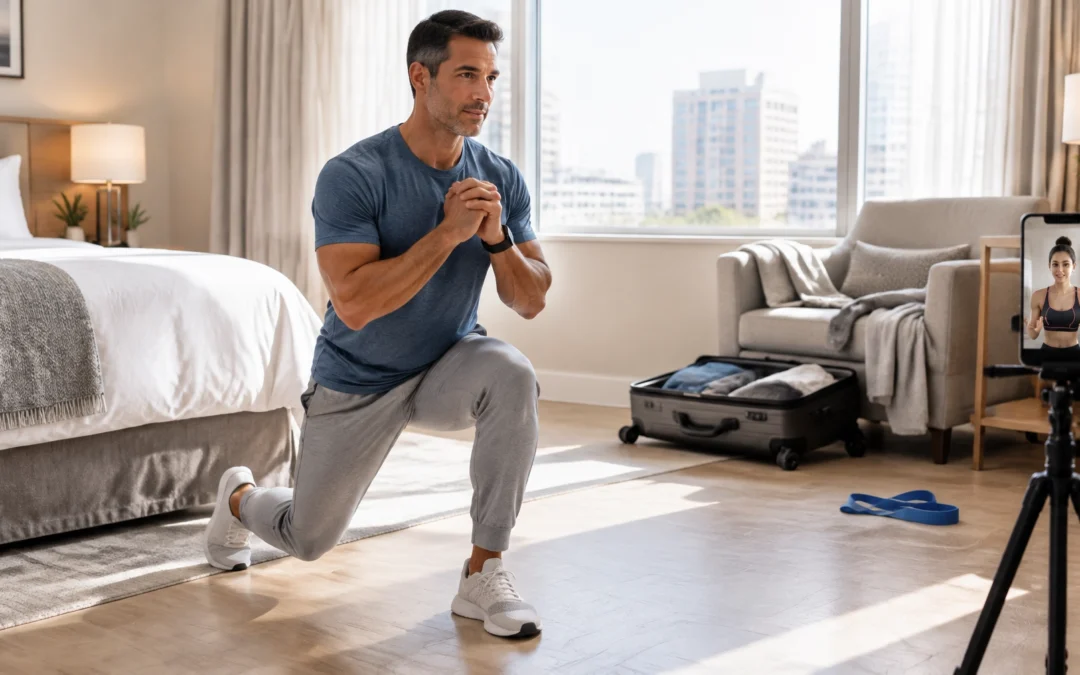
A work trip can throw even a solid fitness routine off course. Your flight lands late, meetings shift, and the hotel gym is closed, or it’s open, but the equipment you need is already taken. Add jet lag and an unfamiliar schedule, and it’s easy to tell yourself you’ll get back to exercise when you’re home.
You don’t have to wait. With remote personal training, you can fit a focused, coached workout into your hotel room, without relying on gym hours or adding another trip to your day. The goal isn’t to make every travel week perfect. It’s to keep a realistic routine going, adjusted to the time and energy you actually have.
Why work travel makes workouts harder
Travel interrupts the cues that usually help you exercise. At home, you might know when you have a free hour, where your gear is, and what workout is next. On the road, you’re dealing with new surroundings and a calendar that can change by the minute.
Hotel gyms can be inconvenient or unpredictable. You may not know what equipment is available, whether the room will be crowded, or if you’ll have time to go downstairs between meetings. Your energy can also vary: a session that feels manageable after a good night’s sleep may be a poor fit after a late arrival or an early flight.
The answer isn’t to force your usual routine into different circumstances. It’s to make the routine more adaptable. A workout in your room can be short, equipment-light, and scaled to how you feel that day.
What actually works in a hotel room?
You don’t need a fully equipped gym, or a big patch of floor. A clear, safe space is enough for many bodyweight movements, and a light resistance band can offer extra options if you already own one. You might build a session around squats or supported split squats, hip hinges, glute bridges, wall or incline push-ups, and a core exercise such as a dead bug.
Furniture requires a little more caution. A sturdy chair may be useful for balance or support, but check that it is stable and won’t slide. Avoid standing on furniture, anchoring bands to anything that could shift, or using unfamiliar items as weights. Your hotel room is not a place to test a wobbly setup.
A 20–30 minute session can be plenty for a focused travel-day workout. For example:
| Time | Focus |
|---|---|
| 3–5 minutes | Gentle warm-up and mobility |
| 15–20 minutes | A few controlled lower-body, upper-body, and core movements |
| 2–5 minutes | Easy cooldown and breathing |
The exact exercises, pace, and number of rounds should reflect your experience, available space, and energy. If you’re new to exercise, returning after a break, or managing an injury, ask a qualified professional to adapt the plan to you.

A live coach makes an unfamiliar space easier to navigate
Pre-recorded workouts can be useful, but they can’t see the space you’re in or respond to what’s happening in real time. A live trainer can help you choose a variation that fits the room, offer form cues as you move, and adjust the plan if your energy or schedule changes.
That difference matters when you’re traveling. Maybe the floor space is limited, a movement doesn’t feel right, or you’ve only got 20 minutes before your next call. With online personal training, your coach can adapt the session instead of asking you to follow a plan that no longer fits.
Live accountability can help, too. Knowing a real person is expecting you can make it easier to start when travel has disrupted your usual routine. And the session isn’t set in stone: your coach can help you choose a lighter option when you’re tired and a more challenging one when you’re rested. Remote coaching won’t remove jet lag, but it can help keep movement and consistency in view while you travel.
That same flexibility can suit people outside the hotel room, too. If you’re comparing 1-on-1 virtual workouts for home office workers, the principle is similar: bring tailored, live guidance to the place you already are.
Let jet lag and sleep shape your session
A demanding travel day isn’t the moment to prove how tough you are. If you’re very sleepy or feeling the effects of jet lag, scale back. A short walk, gentle mobility, or an easier strength session may be a better fit than high-intensity intervals or heavy effort.
Did You Know? The World Health Organization recommends that adults aim for 150–300 minutes of moderate-intensity aerobic activity per week, along with muscle-strengthening activities on at least two days. That weekly target can be built from different kinds of movement. It doesn’t require a long gym visit every day. See the WHO’s physical activity guidance.
Jet lag can affect sleep, alertness, and concentration. The CDC’s guidance on jet lag disorder explains that symptoms can include sleep disruption and daytime sleepiness. If you’ve had a rough night or an overnight flight, let your trainer know before the session. You can agree on a lighter plan or move the workout to a better time rather than pushing through a session that doesn’t suit you.

Book around the flight, not the other way around
Travel schedules change. A meeting runs late, a flight is delayed, or a window opens unexpectedly. phyt.live lets you book sessions ahead of time or, when availability allows, within the hour. That gives you options: reserve a slot before the trip, or look for a session when your day finally opens up.
Because the session is virtual, there’s no need to travel to the hotel gym or fit in a commute. Find a clear space, set up your phone or laptop, and connect with your trainer from the room. You can also look through the trainer roster to find a certified coach whose experience and approach fit your goals.
If time is tight, tell your trainer what’s realistic before you begin. A clear 20-minute plan is better than hoping for an hour that never appears. If your schedule changes, a brief check-in can help you decide whether to reschedule, shorten the session, or switch to an easier day.
Make a travel-week plan with a backup option
Before you leave, think through what a successful week could look like, not an ideal week, but a workable one. Consider your flight times, local schedule, sleep, and how much space you’re likely to have. You could plan a couple of coached sessions, then use walking or short mobility breaks as additional ways to move.
It also helps to set a backup. If a call takes over your workout window, could you do a shorter session later? If you’re exhausted after arrival, could the day’s goal be a gentle walk and an earlier bedtime instead? A flexible plan gives you a way forward without treating one change as a reason to abandon the whole week.
For more ideas about a manageable routine without the commute, explore building strength at home in under 25 minutes a day.
Keep the habit, even when the setting changes
Travel may change your routine, but it doesn’t have to erase it. You can train in a hotel room, use simple movements, and adjust the session to your available time and energy. Remote personal training brings a coach into that process, so you get live guidance instead of trying to solve every travel-day decision alone.
Think about it: no commute to the gym, no need to count on unfamiliar equipment, and a session built around your schedule. That’s one practical way to figure out how to stay fit without a gym commute, even when work takes you away from home.
Ready to see how live coaching fits your routine? Try a complimentary 60-minute first session, up to a $100 value, with no commitment required.
Suggested Tags & Categories
- Categories: Online Personal Training, Fitness for Busy Professionals, Travel Fitness, Strength Training, Health & Wellness
- Tags: Remote Personal Training, Online Personal Training, Hotel Room Workouts, Business Travel Fitness, Virtual Coaching, Workout Consistency, No Gym Commute, phyt.live