
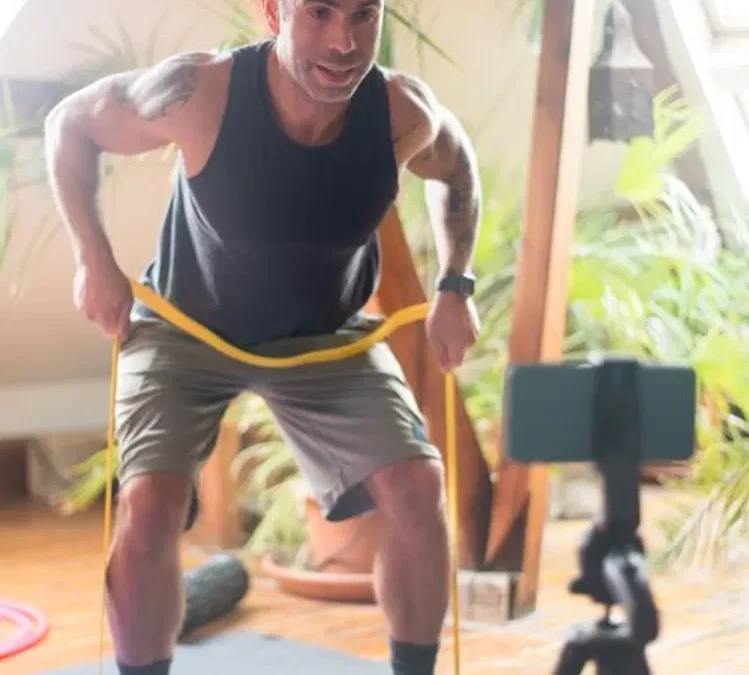
Your calendar is full, your workday may stretch well past dinner, and the gym can feel like one more appointment to fit in. If strength training keeps landing on your “when things calm down” list, you’re not alone, and you don’t need a perfect schedule or a fully equipped home gym to begin.
What you do need is a simple plan you can repeat, a clear way to make it more challenging over time, and support that helps you follow through. This home strength training program for busy professionals gives you that framework: two full-body sessions a week, a few practical pieces of equipment, and a progression system you can track.
Start with a plan that fits real life
A common trap is trying to make every workout exhaustive. When your plan depends on long sessions, lots of equipment, or an uninterrupted week, a late meeting can derail the whole thing.
Instead, establish a baseline you can protect. Schedule two full-body strength sessions on nonconsecutive days, for example, Tuesday and Friday. Keep each appointment realistic for your current routine. If a week gets hectic, reschedule rather than treating one missed workout as a reason to abandon the plan.
Did You Know? The World Health Organization recommends muscle-strengthening activities involving all major muscle groups on at least two days each week. That’s a practical starting target, not a demand to train every day. See the WHO physical activity recommendations.
Think about it: if your equipment is already at home and your session is on your calendar, what barriers can you remove before the week begins?
The framework: six movement patterns, two sessions
You don’t need a long list of exercises. Build each workout around patterns that train your legs, hips, upper body, and trunk. Repeat the same basic structure for several weeks, using a variation that matches your current ability.
| Movement pattern | At-home options |
|---|---|
| Squat | Chair squat, bodyweight squat, or backpack squat |
| Hip hinge | Backpack or dumbbell Romanian deadlift |
| Push | Wall, counter, or floor push-up; dumbbell floor press |
| Pull | Resistance-band row or backpack row |
| Single-leg work | Supported split squat or step-up on a stable step |
| Trunk stability | Dead bug, bird dog, or plank |
Start with one or two controlled sets of 8–12 repetitions per exercise. For planks or similar holds, use a duration you can manage without losing position. As you get comfortable, you can build toward two or three sets. Rest long enough between sets to do the next one with good technique: there’s no prize for rushing.

A session might pair a squat with a push-up, then a hip hinge with a row, followed by single-leg work and a trunk exercise. You can do one movement at a time or alternate between two different patterns while allowing each area to recover. Keep the setup simple: a mat, a resistance band, and a backpack you can load with household items may be plenty to start.
For safe loading, use a stable chair or step, check that bands are in good condition, and make sure your training space is clear. Choose a version that lets you move smoothly through a comfortable range. Stop if you feel sharp pain, dizziness, or unusual shortness of breath; speak with a health professional if you have a medical condition or aren’t sure what’s appropriate for you.
Use progressive overload to keep getting stronger
Repeating the same workout builds a routine. Gradually increasing the challenge gives your body a reason to adapt. That principle is called progressive overload, and it doesn’t mean pushing to your limit every session.
Try this simple “double progression” approach:
- Choose an exercise variation and a target range, such as 8–12 repetitions.
- Keep the movement and resistance the same while you build clean reps.
- When you can complete 12 controlled repetitions on every set across two workouts, make one small change.
- Add a little resistance, choose a stronger band, increase the range of motion, or move to a harder exercise variation. Then build back up from the lower end of your rep range.
The American College of Sports Medicine’s 2026 resistance-training overview describes progressive loading as one way to support strength gains. You don’t have to chase heavier weights every week. A consistent log helps you notice progress in reps, resistance, control, or confidence.
Write down the exercise, variation, resistance, sets, and repetitions. If you finish a set feeling you could have done several more reps with good form, consider a slightly harder option next time. If your technique starts to slip, stay with the current version, or scale it back. Quality is part of progress.

Keep a simple A/B schedule
To make your plan repeatable without making every week feel identical, alternate two sessions. Keep the same movement patterns, but vary the exercise choice when you have an appropriate option.
Workout A
- Chair squat
- Incline push-up
- Resistance-band row
- Backpack hip hinge
- Dead bug
Workout B
- Supported split squat
- Dumbbell floor press or a push-up variation
- Backpack row
- Glute bridge or hip hinge
- Side plank or bird dog
Begin with one or two sets per movement. Add sets or resistance gradually as your recovery and technique allow. A trainer can help you adjust the exercises to your space, experience, equipment, and goals; the table is a starting framework, not a personalized prescription.
Make the plan easier to stick with
Knowing what to do is only one piece. A demanding week can still disrupt the best-intentioned routine. Try placing your sessions at predictable points in your calendar, setting out your band or weights beforehand, and keeping your workout notes somewhere easy to find.
And when your schedule changes? Move the session to another realistic slot instead of waiting for a perfect week. A plan that adapts is more useful than one that only works under ideal conditions.
This is where online personal training can make a meaningful difference. In 1-on-1 virtual workouts for home office workers, a certified trainer can watch your movement live, coach your technique, and help you choose a suitable progression. You can train in your own space, without a commute, and book around your day. That’s the practical advantage of remote personal training: personal guidance with a format designed for flexibility.
If you’d like a more condensed routine as a separate option, explore our guide to building strength at home in under 25 minutes a day. This article focuses on the repeatable strength framework (movement patterns, progression, and accountability) so you can build a plan that lasts beyond a single workout.
Your next step can be small
Real strength is built through manageable sessions repeated over time, not by waiting for a clear calendar or a spare room full of equipment. Start with two days, choose movements you can perform well, and track one small sign of progress each week. You’re building more than strength: you’re making space for energy, resilience, and focus in a busy life.
Want help shaping the framework around your goals and home setup? phyt.live offers live, one-on-one coaching with certified trainers. Try a complimentary 60-minute first session, up to a $100 value, with no commitment, and experience the difference real-time guidance can make.
Suggested Tags & Categories
- Categories: Online Personal Training, Home Workouts, Strength Training, Fitness
- Tags: home strength training program for busy professionals, online personal training, 1-on-1 virtual workouts for home office workers, remote personal training
Want the complete picture? Read our guide to home strength training for busy professionals: expert guidance, a simple weekly plan and how live 1-on-1 coaching with a certified phyt trainer can help.